Pages

Showing posts with label reading. Show all posts

Thursday, July 24, 2014

Keeping up with Book Boxes- a management tip


This system works so well! Each group has a specific day of the week they are allowed to change books. While everyone else is reading to self, the group of the day is allowed to trade books in the library. The empty squares next to each group is where I write the level they can choose from. It's so simple. It takes a little bit of training, but then book trades run themselves.This leaves me open to conference with other students. Not sure if this is a mind blowing tip, but when I had teachers come observe last year, this is what they raved about so I thought I'd share the idea. :)

Monday, July 21, 2014

Read Like a Detective

Hello, Friends!
I have been MIA on this blog for quite awhile now, but I'm back!

For some reason last year threw me for a loop. I started the year with thirty firsties and had to split my class up in January because we added a teacher. It was so hard! I really hope I don't ever have to do that again.

I wanted to share something I worked on this summer after working on curriculum for my district in June. We started to design assessments for our Common Core Frameworks and are modeling them close to PARCC (a Common Core assessment consortium). We also reviewed and helped re-vamp the AZAC which is a Arizona reading comprehension test starting in 2nd grade. As a first grade teacher, reading the 2nd grade tests made me realize my students need to be exposed to these types of multiple choice text-based evidence questions in first grade. We can work through the questions together in whole group and small groups to better prepare them for 2nd grade when they need to be able to answer them independently.

Sooo... this summer, I started writing original passages to use when teaching the RL and RI standards. I am so excited to use these. The hardest part about teaching Common Core for me is finding passages that fit my needs at the primary level. I use Read Works all the time but they don't have skill specific passages for Kinder or First Grade. These are going to save me so much time next year!


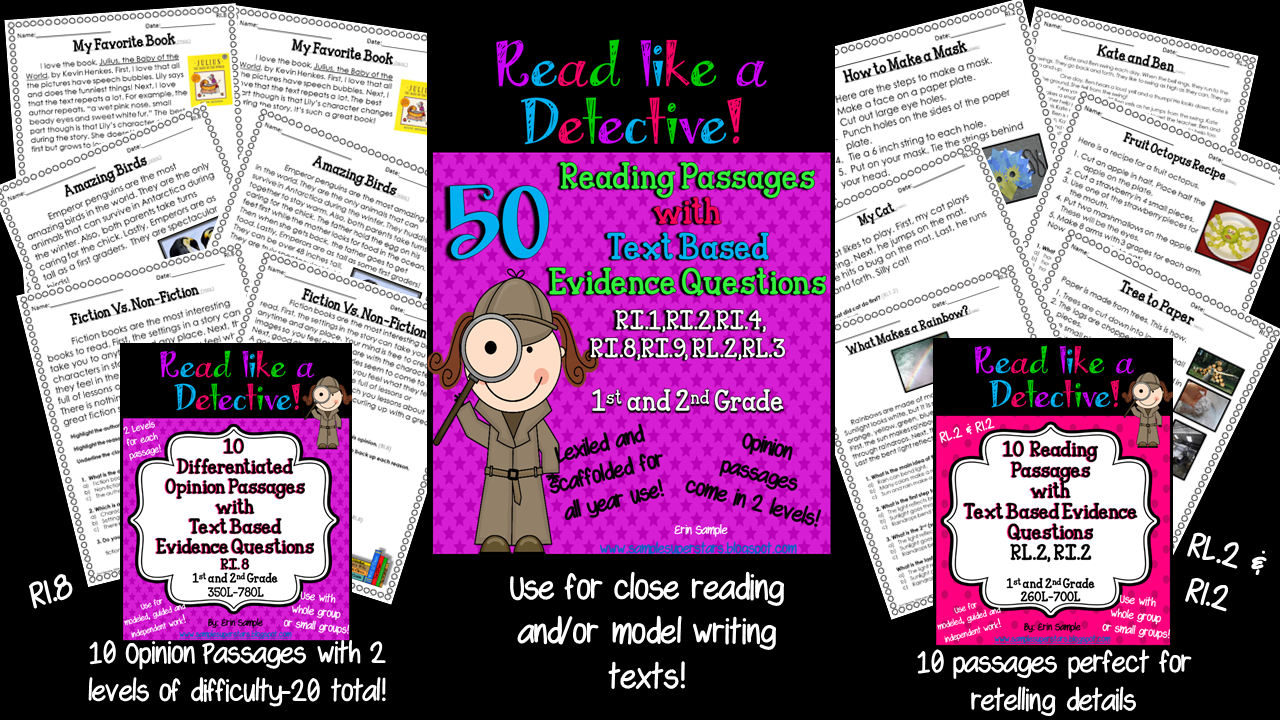
These 50 passages are bundled or you can buy them separately if you only want a specific standard. The standards addressed in these passages include: RL.2,RL.3,RI.2,RI.4,RI.8,RI.9.

Here is what is included in the bundle:

-10 passages that focus on RL.2& RI.2
 

Students will practice retelling text with key details. There are 5 literary texts and 5 informative/explanatory texts including a how-to and a recipe.

-10 paired passages that focus on RI.9 
Students will find similarities and differences between two texts on the same topic.


-10 passages that focus on RL.3 

These passages will allow teachers to teach students to describe characters, setting and events. These passages also include developed characters that will allow students to describe a character’s traits and justify with evidence from the text. Most primary texts do not have well developed characters so teaching this skill is difficult unless done during a read aloud. Central message is also reinforced in these passages.


-10 Differentiated Opinion Passages that focus on RI.8 20 passages total! 

The best part is that I have included 2 levels of opinion pieces with/ without details/explanations for each support. This will allow for differentiation as well as the opportunity to use the passages as a writing lesson for students who are ready to add details/explanations to their supports. In order to write opinion pieces well, students need to have read many opinion pieces and studied the structure of this type of writing. 

If you're interested in these passages, click here to go to my TPT site.

Monday, September 16, 2013

Story Elements Reader's Theatre Freebie!

I have an awesome freebie for you today! I wrote a short Reader's Theater about story elements. This really helps my students with the vocabulary of story elements and serves as an anchor all year.
I seriously can ask my students in May, "class, what's a solution?" and everyone answers "how they fix the problem!" with some hammering to follow. :)

Click here to download the file from Google Drive.

This week,we will be working on diving deeper into the Story Elements to "describe" the characters, setting, problem and solution.

Check back soon (or follow me!) for a great close reading lesson that focuses on describing characters! 

Meanwhile, enjoy this short video of my kiddos performing their reader's theater. This performance was in our classroom 5 min before the bell on Friday; so, it's a little rougher than the performances we took on the road earlier that day. :)


Tuesday, January 22, 2013

I've leveled my students. What next?

Have you ever leveled your students, progress monitored or looked at your DIBELS scores and thought, "Okay, what now?"

A few years ago, I really began to think about how I teach reading and what assessments I could use to better inform my instruction. I used Running Records to level my students but I didn't have a strong gasp on where to go next instructionally. I needed something that would measure what skills my students were applying when reading decodable texts. I wanted to know what skills I needed to explicitly reinforce. It's hard to tell that from a leveled text. I soon developed these Phonics Reading Assessments. ( I'm not sure if that's a good name for them or not. I don't think it gives a good idea of what they are. Any suggestions?)


These tests have transformed the way I teach reading. Now I can make sure my instruction matches needs and I can pull texts that reinforce the skills the students need. I see great growth in a short time. Out of 28 students this year, I had over 10 who couldn't even read short vowel words in August. Now I have 25 who are at grade level or above. I really think the growth is from providing the right instruction at the right time. These assessments not only help you plan for your strugglers but challenge your high reader as well.

There are 4 assessments and the best part is that each assessment breaks down the phonetic components so you can see the areas to work on next.  The students just read the sentences on a student copy while you follow along just like a Running Record. After the student is finished, you can tally errors and begin to really analyze the student's mistakes. Here are the assessments:

The short vowel assessment is more basic because it tests the 5 short vowels and 3-4 phoneme words. This assessment will show you if a student is missing a particular vowel sound, not blending properly or unable to blend more than 3 phonemes.


Once students can read short vowels fluently, you can give the short vowel blends assessment. This test includes every beginning and ending blend, beginning digraphs and 4- 5 phoneme words. This assessment gives so much information! You will also be able to analyze short vowel errors because many times I've seen students who begin making short vowel errors once they start decoding 5 phoneme words.


The third assessment focuses on long vowels,  r- controlled vowels and common dipthongs.  Due to an increase in text complexity at this level, students are also assessed on their ability to decode words with inflectional endings, compound words and multisyllabic words.


The last assessment looks at a student's ability to apply more advanced phonetic skills. Less commonly used dipthongs, digraphs, long vowel patterns, soft "c" and "g" and inflectional endings are among the skills tested.


If you're interested in these assessments, click here. I think they could really help;especially if you find yourself asking, "what next?"